September 3, 2026
What is the Purpose of the Church? Evangelism vs. Discipleship
Written By Grace Theological Seminary
Tagged With Preaching & Pastoring Ministry Dr. John Teevan
By: Dr. John Teevan
The purpose of the church is both to make disciples and to proclaim the Gospel. Rather than choosing between evangelism and discipleship, Scripture calls the Church to faithfully do both. Jesus commissioned His followers to “make disciples of all nations” (Matthew 28:19-20), which includes reaching unbelievers through evangelism while helping believers grow in spiritual maturity through discipleship. Healthy churches intentionally pursue both responsibilities as they fulfill God’s mission.
For pastors and ministry leaders, faithfully balancing evangelism and discipleship requires biblical wisdom, practical ministry experience, and a deep understanding of Scripture. That’s why theological education plays an important role in preparing leaders to shepherd the Church faithfully.
A Picture of the Church’s Mission
Anyone who follows popular American sports understands there is a stark contrast between basketball and football. In basketball, the same people play offense and defense, while in football, there are two different squads: one for offense and another for defense.
Here’s a warm-up question to get you thinking with me today. Can a basketball player excel at both offense and defense? My answer is…usually not. Consider this: there are many all-time offensive players in the NBA, but Michael Jordan and Hakeem Olajuwon are also among a much smaller group of MVPs who, in addition to great offense, are also among the very best defensive players as well. What I’m saying is that it’s rare.
Evangelism vs. Discipleship
Now let’s talk about the purpose of the church: are the efforts and focus of each local church more like the basketball model or more like football? Should there be different groups who are focused on offense while others concentrate on defense? Or should all Christians be practicing both sides of this proverbial game? Maybe we should begin by defining some terms.
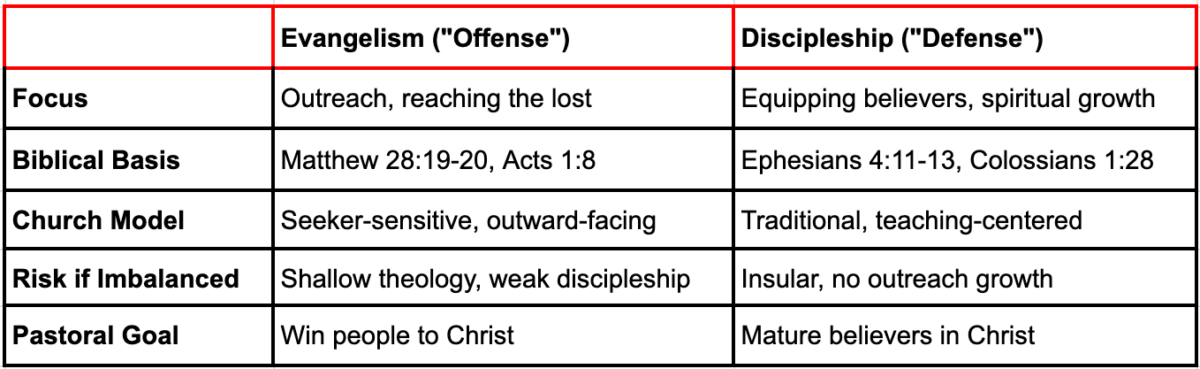
Let me define church defense this way: whatever is good for the believers is defense. This would include discipleship and worship programs. So what does offense look like for the Church? (Playing offense… not being offended.) For the sake of this word picture, my idea of offense is whatever is aimed at outreach.
Church Leadership
Church programs have used the basketball model with discipleship and worship (defense) and evangelism, but mostly they delegate outreach to occasional special meetings (offense). Are we really pretty good at both? Just as with the typical MVP in the NBA, I think that the typical church plays one role much better than the other, and, more frequently, our better role is defense. Historically speaking, until the 1960’s, churches playing on the basketball model were extremely common; however, good they might have been at defense, they were not good on offense.
Enter the seeker-sensitive movement of the 1980’s and 90’s, bringing a focus on offense, and a generation later, many large churches have switched to a clear focus on offense. They seem to leave discipleship (defense) up to home groups.
The defense model churches scorn the offense model churches as having abandoned theology and the Bible, citing that they refuse to sing songs about the finished work of Jesus. Offense model churches scorn (and actually ignore) the defense model churches as being irrelevant.
Purpose of the Church
Multiple books have been written about how churches should play defense by equipping the saints, preaching the word, and training up children and youth. Other books encourage churches to focus on mission and outreach. Defense churches focus on the Bible and theology, while offense churches focus on the context and touch points of the lost people they hope to attract. The differences are real, but not contradictory.
Why not both? It turns out that the larger offense model churches also have pretty good defense. The church provides programs for children and youth and promotes small groups for adults. Some pastors believe the main reason they have Sunday mornings is to get people into small groups. This can begin to sound like having two squads, as they do in football. In reality, all Christians will have strengths that align with one squad or the other, but the Kingdom of God will require them to practice both.
So, how do we solve the challenge of churches and church leaders accusing one another of having an incomplete focus? Let’s not allow a theology-first approach to ministry to hinder the work of those who are theology-last people. Let’s also not allow the latter, who have a context-first approach to ministry, to forget the purposes for which Jesus established the Church in the first place.
Church Leadership Training
The purpose of the Church is just one of the weighty matters with many levels of complexity to consider. It necessitates pastors and ministry leaders who are equipped to train up people who are willing to play both offense and defense.
For pastors and ministry leaders, leading a church that values both evangelism and discipleship requires biblical conviction, theological discernment, and practical ministry wisdom. Those are qualities that are developed over time through faithful ministry, intentional mentorship, and theological education.
At Grace Theological Seminary, students are equipped to faithfully preach God’s word and disciple believers. If you’re considering a career in ministry, check out the theology-rich programs and diverse delivery methods of Grace Theological Seminary.

John Teevan
John Teevan is the Adjunct Professor in the Seminary and SOMS. He has taught a variety of courses since 2000. He comes from two long pastorates and twelve years working for Grace College in the Indiana State Prison system as an educator/director. He also served in the four cities where Grace worked to open commuter sites. These diverse experiences along with community involvement have sensitized him to social side of ministering to people in a variety of situations. A five-year engagement with the Acton Institute led to the publication of his book on Social Justice.
FAQ's
-
The purpose of the church is both to make disciples through evangelism (Matthew 28:19-20) and to equip believers for spiritual maturity through teaching and fellowship (Ephesians 4:11-13). Scripture presents these as complementary, not competing, priorities.
-
Neither should be sacrificed for the other. Churches historically have tended to specialize in one, but healthy, biblically grounded churches integrate both outreach and spiritual formation rather than treating them as separate “teams.”
-
Seeker-sensitive churches emphasize accessibility and outreach to non-believers, while traditional churches emphasize theological depth and discipleship. Both models carry strengths and risks when taken to an extreme.
-
Limited resources and leadership focus often push churches toward one strength. Pastors trained in both biblical theology and practical ministry are better equipped to build balanced, sustainable churches.
-
A Master of Divinity equips pastors with the theological foundation and practical ministry skills to lead churches that pursue both evangelism and discipleship faithfully, rather than defaulting to one at the expense of the other.
Share
Tagged With Preaching & Pastoring Ministry Dr. John Teevan